
UK Government: Action vs Inaction

The Government is failing to match its climate promises with meaningful action. Despite clear warnings that the UK is not cutting emissions fast enough, ministers continue to ignore the central role of intensive animal agriculture, refusing to set targets to reduce the scale of factory farming or meat consumption. Voluntary schemes, vague roadmaps and empty ambitions are no substitute for decisive action. By failing to confront factory farming and support a properly funded transition to plant-based farming, the Government is allowing a damaging food system to continue at the expense of the climate, wildlife, animal welfare and future food security. The evidence is clear – the Government knows what needs to change, yet its policies fall woefully short of what the crisis demands.
What the Government is doing
The UK Labour government says it is working towards the legally binding target of net-zero greenhouse gas emissions by 2050. It has promised to deliver ‘clean power’ by 2030 – meaning at least 95 per cent of Great Britain’s electricity generation from clean sources – alongside more renewable energy, efficiency measures and emissions reductions in transport and industry. These are meaningful ambitions on paper, but whether they will be delivered at the speed the climate crisis demands remains to be seen.
In farming and food production, the Government relies heavily on incentives rather than mandates. The Sustainable Farming Incentive (SFI) pays farmers for practices such as improving soil health, managing nutrients more carefully and creating habitat for wildlife.
The SFI was meant to reward farmers for protecting soil, water and wildlife. Instead, it became a six-hour dash for a £233 million pot – environmental policy run like a Glastonbury ticket sale, with farmers competing against the clock rather than being supported through a planned transition.
Although these measures may help, they are voluntary, modestly funded and dependent on individual farmers being able to participate – hardly the systemic transformation needed.
Agriculture was responsible for nearly 50 million tonnes of greenhouse gas emissions in the UK in 2024, 62 per cent of that was from farmed animal production. Animal agriculture is a major emissions driver because raising animals for food generates high levels of greenhouse gases, particularly methane from digestion and manure and nitrous oxide from fertilisers and slurry. In other words, the sector’s climate problem is not marginal or technical: it is built into the current scale of livestock production. See more here.
The Government’s Farming Roadmap 2050 promises a more sustainable and climate-resilient food system through reduced reliance on fertilisers, better water management and agricultural innovation. It is a long-term framework of plans, consultations and aspirations extending to 2050. It faces criticism for lacking long-term funding, shifting financial risk onto struggling farmers and offering ambitious goals with few concrete plans for delivery.
The Government also promotes tree planting, peatland restoration and improved food-waste management. These are worthwhile, but they risk functioning as the familiar political comfort blanket: visible, relatively uncontroversial measures that can be announced repeatedly while the harder questions on fossil fuels, industrial decarbonisation, livestock emissions, land use and consumption continue to be largely avoided.
In short, the Government has produced targets, roadmaps and payment schemes. What it has not yet demonstrated is delivery at the scale and speed that the climate crisis demands.
What the Government is failing to do
In 2026, three major reports delivered the same message: the UK’s food system must change to protect the climate, restore nature and safeguard national security. Yet one of the clearest solutions – eating less meat and more plants – is still not being addressed. The Government is ignoring the cow in the room!
The Climate Change Committee’s Progress in Reducing Emissions 2026 report warns that the UK is not cutting emissions fast enough and identifies agriculture as a major failure. It says the Government’s plans do not adequately address farmed animal numbers and that ministers still have no pathway for reducing meat consumption, despite long-standing advice that eating less beef and lamb is essential to meet climate targets.
Published the same day, the Government’s Farming Roadmap 2050 admits that “meat production is a significant contributor to greenhouse gases in the farming sector” – but stops short of asking anyone to eat less of it. Instead, it suggests farmers could “diversify into lower emission farming systems where appropriate, for example growing oilseeds and pulses as demand for plant-based foods increases.” In plain English: some farmers might choose to grow protein-rich crops instead of methane-emitting cows and sheep.
The Government’s own Nature Security Assessment warns that biodiversity loss and ecosystem collapse threaten UK national security through food shortages, crop failures, water insecurity and supply-chain disruption.
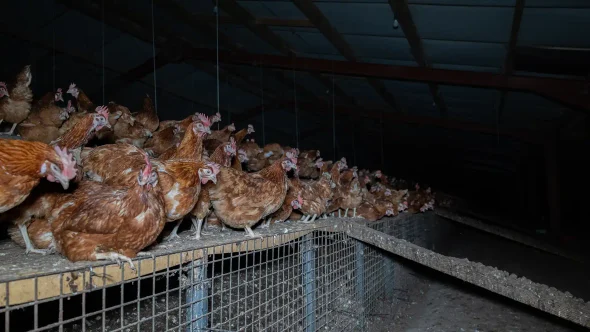
The Government talks about sustainable farming but continues to sidestep the central climate issue: the scale of animal agriculture and its environmental impacts. Factory farming remains legal and agricultural support is increasingly linked to detrimental environmental impacts, yet there is still no national target to reduce farmed animal numbers or meat consumption. Animal agriculture contributes to greenhouse gas emissions, water and air pollution, land-use pressures and wildlife loss, while imported animal feed is linked to deforestation.
The SFI rewards farmers for measures such as improving soil health, managing nutrients and protecting wildlife, but it does not challenge the scale of animal food production. The Farming Roadmap 2050 promises a more sustainable and resilient sector, yet its proposed measures focus largely on efficiency, technology and lower-emission farming practices, rather than a planned transition away from intensive animal agriculture. We need to change what we farm, not just how we farm animals.
The Climate Change Committee has been clear that this is not enough. Its Seventh Carbon Budget calls for average meat consumption to fall by 25 per cent by 2040 and 35 per cent by 2050 compared with 2019, with red meat falling by 40 per cent by 2050 and dairy consumption down 20 per cent by 2035. It also calls for cattle and sheep numbers to be reduced by 27 per cent between 2023 and 2040.
The CCC states: “Reaching net zero across the agriculture and land use sectors requires a reduction in livestock numbers,” adding that this can be achieved “by supporting farmers to diversify their income streams and by a reduction in average UK meat and dairy consumption.” It also warns that “land use change at scale will require land to be released from livestock agriculture,” facilitated by dietary change and incentives for farmers to diversify.
Yet the Government has not adopted these recommendations as policy. There are no mandatory livestock-reduction plans, no national programme to shift diets and no clear exit strategy for factory farms.
Tree planting and peatland restoration are valuable, but they cannot substitute for reducing emissions at source.
What needs to change
Viva! calls on the Government to adopt a food and farming strategy that puts the environment, animals and public health at its heart – rather than leaving the most damaging parts of the food system largely untouched. That means setting clear, binding targets to reduce meat and dairy consumption, phasing out factory farming and redirecting agricultural support away from farmed animal expansion and towards plant-based food production.
Viva! says: “Factory farming is a disaster for animals – but it also threatens human health and the environment.” Meat and dairy production account for 60 per cent of global food-production greenhouse gas emissions, while providing only 18 per cent of calories and 37 per cent of protein.
Current schemes such as the SFI pay for environmental improvements, including climate mitigation and animal welfare measures, but they do not challenge the underlying scale of animal agriculture. Viva! says the Government should actively support farmers to transition to sustainable plant-protein crops, including pulses, beans, grains and horticulture, with proper funding, advice and secure markets. See more here.
A fair transition must cut animal agriculture’s environmental damage at its source – without abandoning the farmers, workers and rural communities who depend on it. The Government must fund the shift properly: training, advice, secure markets and real financial support for farmers moving into plant-based and diversified production.
This would also strengthen Britain’s food security. The UK currently imports around 40 per cent of its food and growing more pulses, beans, grains, fruit and vegetables at home would reduce that dependence – while producing more food for people and reducing the amount of crops fed to farmed animals.
At the same time, policy must no longer be shaped primarily by the intensive meat, dairy and egg industries – the large producers, processors, feed companies and lobby groups that profit from the current system. Their influence has helped preserve a model of high-volume animal farming that harms the climate, pollutes waterways, drives poor animal welfare and undermines public health. A fair food and farming strategy would put the interests of people, animals, rural communities and the environment before the commercial interests of industrial animal agriculture.
Public procurement should be used as the powerful lever it is. Schools, hospitals and other public institutions should serve nutritious, affordable plant-based meals as standard, with strong food education and clear support for plant-forward diets. The Government’s existing food strategy emphasises healthier diets higher in fruit, vegetables and wholegrains, but stops short of the decisive shift away from animal products that climate and animal welfare imperatives demand. Stronger, enforceable standards are needed to make plant-based options central rather than optional.
Animal agriculture is a major driver of land use, habitat loss and ecosystem pressure worldwide. Plant-based foods generally need far less land and fewer resources. Shifting towards more plant-based diets would therefore cut emissions, relieve pressure on nature and strengthen food security – precisely what these reports say the UK needs.
The contradiction is stark: the Government accepts the evidence, acknowledges the risks, and still refuses to set policies that actively support lower meat consumption. It relies instead on voluntary change, cautious language and technological fixes – leaving a vast gap between what its own reports demand and what it is prepared to do.
Viva!’s associate director and editor of Viva!life, Tony Wardle, said: “These are scary times and no matter how much some people might like to think that veganism is not political, it is at the very heart of politics – and is why we are so reviled by many. We are witnessing the most damaging game of ‘chicken’ ever devised and ours is one of the few voices of sanity that must now be heeded”.
A genuine transition must tackle the environmental impact of animal agriculture at its source. Anything less is not a food strategy – it is a licence for the same destructive system to continue, with the damage simply relocated, renamed and repeated.


