
Hidden Horror: Undercover Footage Exposes Hens Living in ‘Legal’ Cage Cruelty
Animal welfare organisation Viva! urges consumers to respond to government consultation, as new undercover footage exposes the continued suffering of millions of hens crammed into cages in the UK.
- Over seven million UK chickens live in cramped enriched ‘colony’ cages, which the Government admits “do not fully provide for the physical and behavioural needs of laying hens”
- Viva! is calling on the public to respond to a government consultation on cage reform, as it warns proposed timelines will condemn tens of millions more birds to a life of suffering
- Major UK retailer Farmfoods has publicly abandoned its pledge to go cage-free, while Iceland, Heron Foods and Asda are still stocking caged eggs
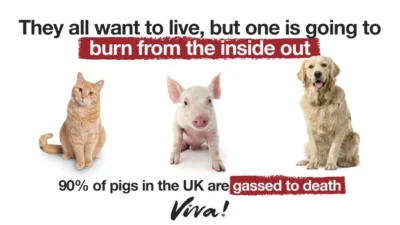
- 40 to 45 million male chicks are gassed to death in the UK each year because of the egg industry
[5 March 2026] – Bristol, UK
For immediate release
Activists from the UK’s leading vegan campaigning charity, Viva!, are calling on the public to respond to a government consultation on keeping egg-laying hens in cages, as undercover footage reveals the “miserable reality” still endured by millions of the caged birds, which supply around 17 per cent of the UK’s eggs.
“What we witnessed at Heal Farms was nothing short of hell for hens: row after row of birds crammed into metal cages, denied freedom, peace and everything that makes life worth living,” says Juliet Gellatley, the founder and director of Viva! and one of the investigators who entered the farm. “Even worse is the fact that over seven million caged hens across the UK are still trapped in those same miserable conditions. So-called enriched ‘colony’ cages are just cruelty rebranded; the egg industry simply swapped one form of hell for another. We wouldn’t dream of forcing our dogs or cats to live a life of such unnatural deprivation, so it’s heartbreaking that this continues to be the miserable reality for millions of these beautiful, intelligent animals.”
Under current proposals, keeping laying hens in cages will not be banned until 2030 at the earliest, though the Government’s preferred timeline – and the one most likely to be enshrined in law – will see the production method remain legal until 2032, condemning tens of millions more hens to a life of suffering.
Enriched colony cages – a life of deprivation
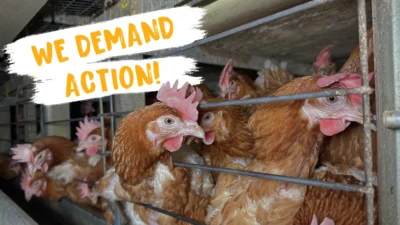
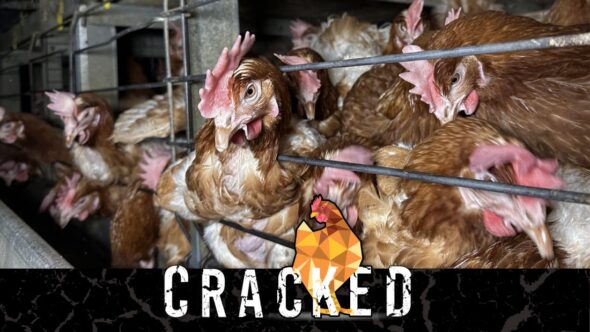
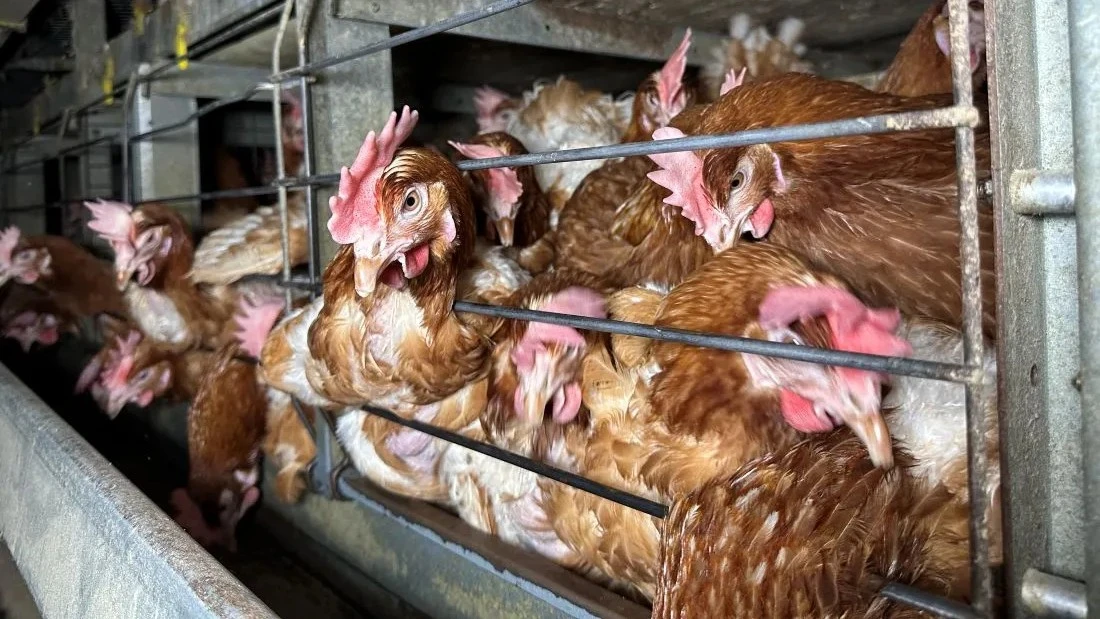
Viva! Campaigns investigators entered a caged egg facility at Heal Farms in Shropshire in May 2023 and December 2025. During both investigations, video footage captured inside the building, which houses thousands of hens, shows dozens of individuals living inside each cramped and dirty cage. The cages are stacked in rows soaring seven levels high, making it all but impossible for the investigators to check on the condition of the hens in the upper levels. Investigators reported on both occasions that the thick cobwebs and dust inside the building, combined with the cloying stench of ammonia from the birds’ droppings, made breathing difficult.
When not perching on plastic/metal bars, the caged hens are forced to stand and walk on bare wire, which can cause painful foot conditions. Many of the birds in the footage are also suffering from feather loss – an indication of stress and/or poor health – overgrown claws and deformed beaks. The latter is caused by the painful trimming carried out to prevent stress-induced injurious pecking, which is common in such crowded cages.
In December, investigators filmed the decaying corpse of a bird left slumped across a perch, just inches away from food and water sources. Space inside the cage is so limited that other birds are seen perching on the corpse – and even pecking at the body, a behaviour that can lead to cannibalism and raises serious concerns about disease transmission risks.
Enriched ‘colony’ cages replaced barren ‘battery’ cages in the UK in 2012 and were supposed to provide hens with a better quality of life. However, under current laws, each hen is given just 750cm2 of space – roughly equivalent to only a postcard’s worth of additional space versus a battery cage, which provided less than an A4 piece of paper’s worth of space – and extreme stocking densities, combined with competition for resources, leave many hens unable to access the small ‘enrichment’ areas. The hens live under artificial lighting their entire lives and are largely denied the ability to express normal behaviours such as walking and running, wing stretching, flapping and flying, dust bathing and scratching through substrate in search of food.

The freedom to express normal behaviour is one of the Five Freedoms developed by the Government’s Farm Animal Welfare Committee (now known as the Animal Welfare Committee), which covers the welfare of laying hens and pullets (young hens that have not yet begun to lay eggs).
Campaigners voice concerns over proposed timelines for cage phase-out
Viva!, which has been campaigning for an end to factory farming for 31 years, is hoping its investigation will add to the pressure facing the Labour Government to follow through on its promise to phase out enrichment cages as part of its Animal Welfare Strategy for England, having admitted that enriched ‘colony’ cages “still do not fully provide for the physical and behavioural needs of laying hens”. Any ban will depend on the outcome of a recently launched consultation.
While the Government’s preferred proposal is a 2027 ban on the installation of new enriched ‘colony’ cages and any other caged systems, followed by a blanket ban from 2032, other proposals leave scope for cages to still be in use over a decade from now. Viva! argues that even 2032 is too far away and is urging the Government to bring this timeline forward, highlighting that tens of millions more hens will experience lives filled with misery and suffering over the next six years.
Crucially, all proposed timelines for an outright ban fall beyond the date of the 2029 general election, leaving animal welfare campaigners concerned that other political parties may not uphold Labour’s pledge.
The consultation closes at 11:59pm on 9 March 2026. Viva! is urging all members of the public to read through the consultation and submit a personal response calling for enriched ‘colony’ cages to be banned as soon as possible. A new petition, meanwhile, calls on the Government to make it’s promise to ban cages a legally binding commitment, regardless of the outcome of the next general election. Readers can sign the petition here.
“While the Government’s intention to phase out cages is obviously good news, we feel it’s imperative to ensure that a ban is enforced on the shortest possible timescale,” says Gellatley. “Given that most hens are gassed to death at approximately 18 months of age and new birds are brought in to replace them, the proposed 2032 date still condemns tens of millions more hens to unnatural, unhappy lives spent crammed inside filthy cages. If countries like Austria and Luxembourg have already banned cages, surely we can bring forward the proposed dates and live up to our reputation as a nation of animal lovers.”

Consumers are against cages – but supermarkets are still selling caged eggs
Polling by consultancy and research firm Bryant Research suggests that even though 94 per cent of the British public are opposed to caging hens for eggs, some major retailers continue to stock eggs from caged facilities. In 2024, Asda released a statement saying: “Asda is committed to growing cage-free egg sales and sourcing cage-free shell eggs by 2025 and are working with our suppliers on improving the welfare of the laying hens. We are also committed to using eggs used as ingredients from cage-free systems by 2025.” Viva! can confirm that Asda was still selling caged eggs under brands including Yummy Eggs as of 19 February 2026. Iceland has missed the December 2025 deadline to stop selling caged eggs while Heron Foods has pushed its deadline to July 2026 and indicated that the move will only apply to shell eggs, not egg ingredients.
Farmfoods, meanwhile, has infuriated animal welfare groups by publicly U-turning on its commitment to stop selling caged eggs, citing an unwillingness “to deny customers access to the good value, nutritious food provided by eggs laid by caged hens”.
While caged eggs are still freely advertised on the shelves of some retailers, Viva! is also warning shoppers that cage cruelty is often hidden inside items such as cakes, biscuits and ready meals.
“Many consumers say they actively avoid buying caged eggs, but what they usually mean is that they avoid them only when buying eggs in boxes or trays,” says Laura Hellwig, managing director at Viva!. “Unfortunately, we know that eggs from caged hens are often used in pre-packed and convenience foods, with unclear, vague labelling making it difficult for shoppers to avoid contributing to the suffering of caged hens.”
Cracked campaign challenges public perception of UK egg farming practices
The release of the investigation marks the start of Viva!’s Cracked campaign, which will span public outreach events, celebrity and influencer partnerships and social media content in the run-up to Easter. The campaign will raise awareness of commercial egg farming – including ‘free range’, which undercover Viva! Campaigns’ investigations show is a misleading label – and offer practical, accessible and affordable solutions to those wanting to explore egg alternatives.
The fate of male chicks will also be addressed: 40 to 45 million a year, considered unwanted by-products of the UK egg industry, are currently gassed to death within just 36 hours of hatching.
“While ‘free range’ farming systems offer an improvement on enriched colony cages, the fact is that all production methods place hens’ bodies under immense strain and dramatically shorten their natural lifespan,” adds Juliet Gellatley. “We don’t need eggs to be strong, healthy or happy, and with so many alternatives available, now really is the time for consumers to crack their egg habit once and for all.”
ENDS
Notes to Editors
- Viva! is a registered charity (number 1037486) and the UK’s leading vegan campaigning organisation
- Heal Farms is located at Hazeldene, Shrewsbury, Shropshire, SY4 4ET and was investigated on 7-8 May 2023 and 10-11 December 2025
- Strict biosecurity protocols, including the use of disposable outerwear and boot disinfectants, were followed by undercover investigators, with the welfare of the hens in each facility considered paramount. At no point did the Viva! Campaigns investigators’ actions cause stress or suffering to the animals being recorded
- Cracked outreach events will take place in Bath and Cardiff in April and May, with press and journalists encouraged to attend. Further information and dates will be shared in due course
- For additional assets and information, contact Rachael Simpson-Jones, PR manager at Viva! – rachael@viva.org.uk