
Art Installation Asks: Why Are We Still Caging Hens in the UK?
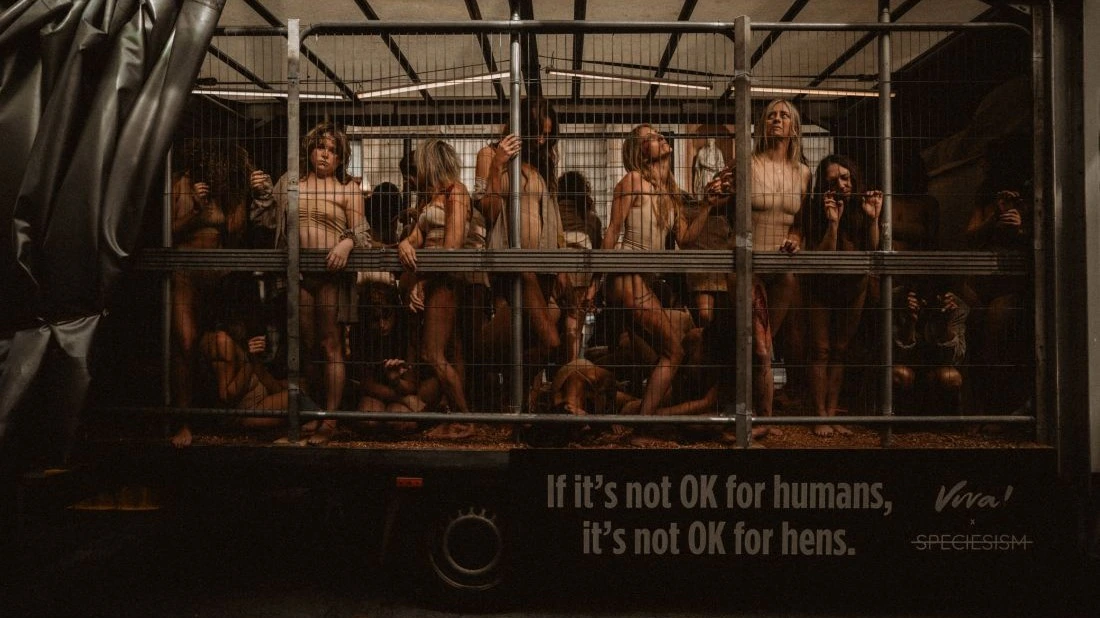
Viva!, in collaboration with SPECIESISM.WTF, brought the reality of ‘enriched’ colony cages to central London at the weekend, as the public awaits the Government’s delayed decision on a potential ban.
[Bristol, UK, 19 October 2026] – A human-size cage appeared outside some of London’s best-known arts & culture venues on Saturday 17 October, containing a group of 37 women raising awareness of the ongoing plight of caged hens.
Around 7.3 million hens bred for their eggs remain confined in ‘enriched’ colony cages in the UK despite the Government itself admitting that these cages “do not fully provide for the physical and behavioural needs of laying hens”. Its consultation on a potential ban closed in March but a final decision has yet to be announced, despite intense pressure from animal rights and welfare reform groups across the nation.
Designed to add to that pressure during the latest stage of the charity’s Cracked campaign, the living artwork was created by Viva!, the UK’s largest vegan campaigning group, in collaboration with artist Stephanie Lane of SPECIESISM.WTF, a not-for-profit aiming to dismantle speciesism through the arts.
Cruelty on show in London
Starting at the Royal Academy of Arts, Viva! and SPECIESISM.WTF’s installation moved on to the National Gallery and finished on Tottenham Court Road. At each location, the volunteer performers confined in the cage confronted the public with the question: “Could you live like this?” Crammed in together, the women found it impossible not to collide with one another as they tried to move around the confined space. Whilst they experienced this for only a few hours, they represented the 7.3 million hens who currently endure this every single day for approximately 18 months – before they’re killed by the industry that trapped them.
Crowds of curious passers-by stopped, watched and asked questions at each location. Many people were surprised to learn that cages for egg-laying hens are still legal in the UK and were encouraged to write to their MP to demand change.
Katie Robinson, campaigns manager at Viva!, says: “We chose some of London’s most iconic and busy locations because we wanted as many people as possible to see the incredible women who stepped up to replace the hens. Their very real counterparts are trapped in their millions in dark industrial sheds across the UK, hidden away from public view. These are sentient, feeling animals who not only have been bred to lay far more eggs than their bodies can sustain but are forced to spend their lives standing on bare wire, in a cage so small that it offers less useable space than an A4 piece of paper. We were so proud to partner with SPECIESISM.WTF on this event because we wanted people to witness that reality and feel empowered to take action.”
By putting people in the place of hens in some of the capital’s most public spaces, the piece asked onlookers to consider a simple question: if this treatment is not acceptable for humans, why is it acceptable for hens?
Stephanie Lane, the artist behind the installation, adds: “As an artist, I believe any medium is a powerful tool for activism and for confronting very difficult themes; it’s a universal language and one of the most remarkable tools we have for communication. When I place humans in the positions occupied by other animals, the message is easily and immediately understood by the viewer without the need to even have a conversation. This cathartic moment is like a turnkey. Many people realise that they have been contributing to normalised violence and make the ethical choice to no longer use the animals referenced through my art.”

‘Enriched’ cages: suffering rebranded
‘Enriched’ colony cages replaced battery cages in 2012 but offered each bird only about a postcard’s worth of extra space, along with token enrichment such as small plastic scratch pads, metal perches and semi-private nesting areas. Each cage typically holds 40 to 80 birds. Around 17 per cent of UK eggs still come from hens kept in cages.
Generations of selective breeding have resulted in hens that lay 20 to 30 times more eggs than they would naturally. This exacts a huge physical toll on their bodies. The industry considers them ‘spent’ at around 18 months old, at which point they are killed and replaced with new birds.
The Heal Farms investigation
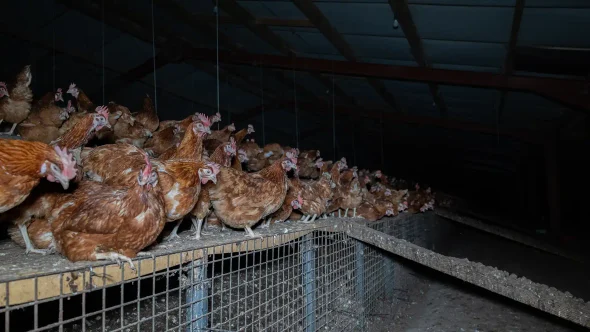
Viva! Campaigns’ undercover investigation at Heal Farms in Hazeldene, Shropshire, shows what this looks like in practice. Investigators visited the site – which houses around 122,000 hens in ‘enriched’ colony cages – in 2023 and again in 2025, discovering filthy, barren cages stacked seven tiers high on both occasions.
The footage documents hens with moderate to severe feather loss, consistent with chronic stress and an inability to escape bullying by other birds. Hens that were not perching on plastic or metal bars had to stand and walk on bare wire, which causes painful foot conditions. Many had protruding keel bones, and routine beak trimming had left some birds with crossed or deformed beaks. Overcrowding makes proper welfare checks difficult; investigators found a dead hen slumped across a perch, inches from food and water, with live birds walking on and pecking at her body.
Mounting pressure on the Government
Cage reform was included in Labour’s 2025 Animal Welfare Strategy for England and a public consultation launched in January closed on 9 March 2026. Ministers have suggested that the Government plans to phase out cages for laying hens by 2032 – but delays mean the public and campaign groups are still waiting for a final decision.
“The Government has the chance to end this suffering and it must do so without further delay,” says Robinson. “It’s been over eight months since the consultation on a ban closed. That’s nearly half a lifetime for a caged hen. We’re urging policymakers to announce their decision so the long-awaited phase out of cages can finally begin.”
Members of the public wanting to take action for hens are encouraged to write to their MP, urging Defra to publish a response before the end of the year and support a legally binding ban on cages for hens.
ENDS
Notes to editors
- Viva! is the UK’s largest vegan campaigning group
- SPECIESISM.WTF is known for its provocative and confronting public art installations, including The Milking Herd
- Images and footage of the installation are available on request. Footage from the Heal Farms investigation is also available
- Interviews can be arranged with Katie Robinson, campaigns manager at Viva!, and with Stephanie Lane of SPECIESISM.WTF
- For media enquiries, contact Rachael Simpson-Jones, PR manager, at rachael@viva.org.uk