Milking inequality – why dairy is a women’s rights issue
I wonder how many women know how cow’s milk is produced, and whether they would continue drinking it if they knew exactly what goes on behind the closed doors of modern dairy farms?
We are shocked and outraged at stories of violence against women – stories of rape, forced pregnancy and forced adoption yet these are all routine in modern dairy farming. We fight for and value the right to choose, to control what happens to our own bodies, yet cows have no choice. These things are done to them over and over again, on an industrial scale.
Most people agree that women should have an equal place in society and the right to control our own sexuality and reproductive system, including access to contraceptives and abortion.
It’s well-documented how sexual violence is used as a means of control and how it is linked to patriarchy, capitalism and other forms of oppression. It wasn’t until 1991 that rape within marriage became a crime in the UK. Before this, husbands were exempt from prosecution for raping their wives, based on the notion that marriage implied consent to sex. It wasn’t until 2003 that the Sexual Offences Act gave ‘consent’ a legal definition in England and Wales, making it clear that consent must be freely given and can be withdrawn at any time.
#MooToo
But while we fundamentally oppose such treatment of women, why is it then okay for humans to violently control an animal’s reproductive system? Can there be a divide between social justice, feminist and animal rights movements? It could be argued that the connections between the reproductive freedom of women and animals are both intrinsically linked to patriarchy, capitalism and other forms of oppression so why pick and choose which form of oppression we oppose? This type of thinking is referred to as speciesism. It involves the assignment of different moral values, rights or special consideration to individuals on the basis of which species they belong to.
The assumption that farmed animals don’t suffer when kept in conditions that would be considered intolerable for humans is largely based on the idea that they are less intelligent than us and have no sense of self. Increasingly, however, research is revealing this to be untrue and as Peter Singer, moral philosopher and Emeritus Professor of Bioethics at Princeton University points out, humans vary dramatically in terms of intelligence and rationality. “Do smarter people inherently matter more, morally speaking?” asks Singer.
It’s a misconception that cows are docile and stupid. Research shows that they nurture friendships, bear grudges and become excited over intellectual challenges. Cows are capable of feeling strong emotions such as pain, fear and anxiety. They worry about the future, but can also feel great happiness. Similar traits have been found in pigs, goats, chickens and other farmed animals. Scientists suggest that such animals may be so emotionally similar to humans that welfare laws need to be rethought. Christine Nicol, Professor of Animal Welfare at Bristol University, says: “Remarkable cognitive abilities and cultural innovations have been revealed”.
Another misconception is that it is natural for cows to produce milk constantly. Just like us, a cow only produces milk after a nine-month pregnancy and birth.
The dark side of dairy
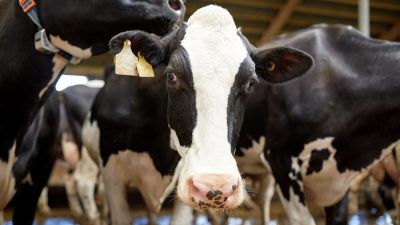
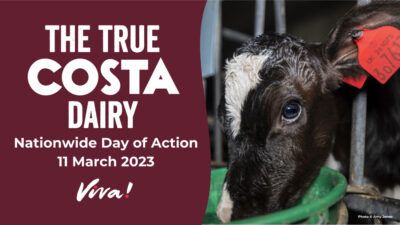
The bucolic image of a cow and her calf in a pastoral setting is a myth – a modern dairy cow will be forcibly impregnated shortly after her first birthday. Soon after giving birth, her offspring will be taken from her so that humans can have her milk. She would naturally suckle her calf for nine months to a year but in dairy farming, calves are often removed within hours. Male calves are of little use to the dairy industry and in 2024, over 80,000 under the age of eight months were killed in the UK, either on farm or in slaughterhouses – the older ones for beef or veal.
The modern dairy cow has been selectively bred over the years to yield ever-increasing quantities of milk and currently produce around 27 litres of milk each day, much more than her calf would naturally drink. A high-yielding cow may be pushed to produce as much as 50 litres per day!
To keep up production, she will be re-impregnated two months after giving birth, meaning that most dairy cows are milked while pregnant for much of the year. Steel shackles are sometimes used on her hind legs to stop her doing the splits if she has suffered muscle or nerve damage during calving.
This intensive physical demand puts a tremendous strain on her and while she is still young she is likely to suffer from infertility and infections such as mastitis and laminitis, cutting short her economic and productive life. Physically ravaged from the abuse she has experienced, she is eventually killed to be eaten in cheap products such as mince, burgers, pies and low-grade ready meals. The average lifespan of a modern dairy cow is about six years and three or four lactations, when she could naturally live for at least 20 years.
Why then, do we turn a blind eye to this appalling treatment of dairy cows? Milk is the product of exploitation of the reproductive capacities of female bodies – for profit.
“I am a vegan-feminist because I am one animal among many, and I don’t wish to impose a hierarchy of consumption upon this relationship.” Carol J. Adams
American writer, feminist, activist and animal rights advocate, Carol J. Adams, was just 23 when she realised a connection existed between feminism and vegetarianism, between meat-eating and a patriarchal world. In her groundbreaking book, The Sexual Politics of Meat: A Feminist-Vegetarian Critical Theory, she examines the links between different forms of violence used against human and non-human animals.
Cows share with us the basic brain architecture responsible for emotion. Mother cows feel distress when their offspring are taken from them, they cry and bellow. They are still grieving as the milking machines suck milk from their udders. A torturous cycle of physical and emotional torment is enforced upon them until they break. In short, milk comes from a grieving mother.

About the author
Dr. Justine Butler
Justine joined Viva! in 2005 after graduating from Bristol University with a PhD in molecular biology. After working as a campaigner, then researcher and writer, she is now Viva!’s head of research and her work focuses on animals, the environment and health. Justine’s scientific training helps her research and write both in-depth scientific reports, such as White Lies and the Meat Report, as well as easy-to-read factsheets and myth-busting articles for consumer magazines and updates on the latest research. Justine also recently wrote the Vegan for the Planet guide for Viva!’s Vegan Now campaign.
View author page | View staff profile