
Stories About Hot Dairy Cows Have One Glaring Omission
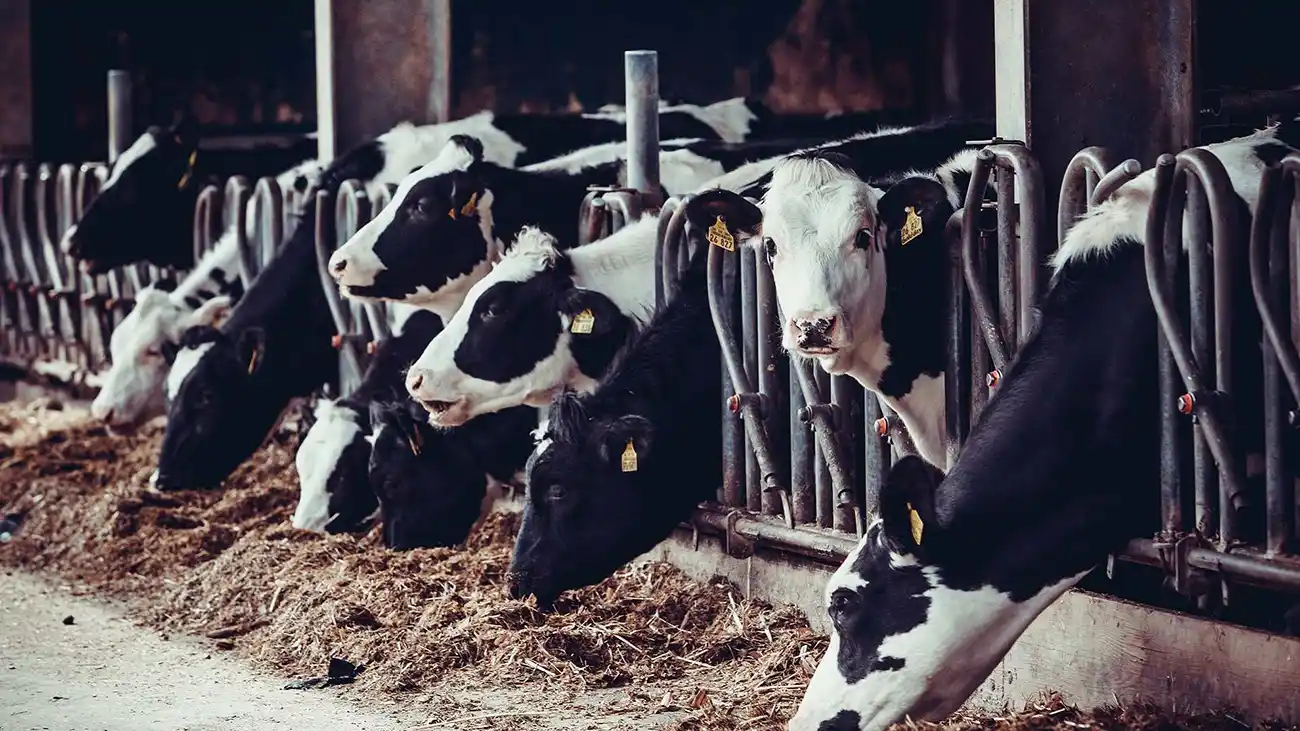
Stories of plummeting milk yields, heat-stressed animals and creative cooling methods abound as the UK’s sweltering summer wears on – but the causes of climate change remain conspicuously absent in coverage.
This summer, cows have been all over the news.
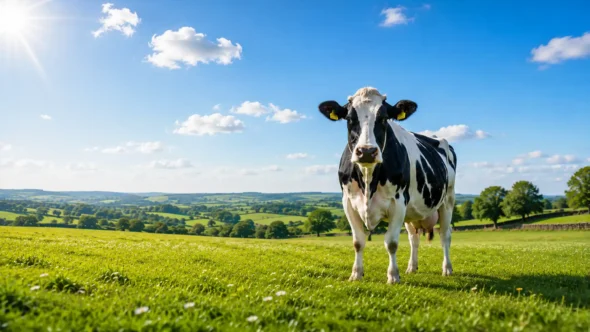
As the UK sweltered through record-breaking heatwaves in May, June and July, the BBC and ITV ran a string of stories about how dairy farmers are trying to cope with the heat. Cows in Cornwall being kept indoors during the day. A Warwickshire farmer watching his herd’s yield drop by a fifth. A Leicestershire farmer rigging up an old bouncy-castle fan to keep his cows cool. A Wiltshire farmer feeding her herd winter silage in July because the grass has simply stopped growing. Another in Wiltshire who’s just spent £15,000 on ventilation and sprinkler systems.
These stories are worth telling. Heat stress is a genuine welfare problem for dairy cows and the farmers featured are dealing with real financial and emotional strain. But look closer and you’ll notice something is missing.
We reviewed 20 pieces of coverage published so far in 2026 – five stories from the BBC and ITV News combined and 15 pieces from trade and industry outlets, including the Agriculture and Horticulture Development Board (AHDB), Farmers Guide, the Energy and Climate Intelligence Unit (ECIU) and Just Food. Every single one framed dairy cows and farmers as the victims of a warming climate. None of the five national news stories and only one of the 15 trade and industry pieces – equating to just five per cent of the coverage – so much as gestured towards the fact that animal agriculture is a major contributor to the greenhouse gas (GHG) emissions that are causing climate change.
That’s not a small oversight. Four of the five national news stories explicitly quote climate experts, mention climate change, or cite the Met Office’s warnings that heatwaves are becoming more frequent because of it. One ITV report went further still, with the farmer telling viewers that “because of climate change, [we] can produce less food for humans”.
Climate change, in other words, is treated as a legitimate news frame – just a one-way one that ignores the fact that it is driven by human activity. It is never held up as something farming, and specifically livestock farming, significantly contributes to.
The only outlier in our review was an academic-adjacent research summary from the International Institute for Applied Systems Analysis (IIASA), which floated the idea that reducing cattle numbers in the most heat-exposed regions could support “climate mitigation” alongside animal welfare and farm resilience. But this piece, too, failed to link the role of farmed animals to our changing climate.
This matters for many reasons.
Firstly, these stories are textbook cases of false balance by omission. Animal agriculture, and dairy in particular, is a well-documented contributor to global methane emissions. The UN’s Food and Agriculture Organisation and the International Panel on Climate Change (IPCC) have both quantified this repeatedly.
In fact, dairy farming fuels the climate crisis twice over: forests are cleared to graze cattle and to grow crops such as soya to feed them, with millions of tonnes imported into the UK every year to meet the demands of the country’s dairy herd and other farmed animals. This deforestation releases stored carbon and destroys one of our best defences against global heating – and then dairy cows emit all that methane on top.
A story that discusses climate change causing heat stress in dairy cows, without once mentioning that the dairy sector is a large part of what’s warming the climate, isn’t neutral reporting. It’s incomplete and unbalanced in a way that happens to flatter the industry being covered and glosses over the harder-to-swallow facts. To use a simple analogy, it’s like climbing a tree, sitting out on a long limb, and sawing off the branch near the trunk while complaining that it feels unstable.
Secondly, this isn’t a one-off editorial choice or journalistic outlier. This pattern holds true across four separate BBC and ITV regional newsrooms, as well as the trade press and industry platforms that cover dairy and the climate for a living. When the AHDB’s own lead dairy analyst is quoted warning that “severe heat events are likely to become a more common feature of British summers”, with no follow-up question by the journalist about what’s driving that trend, you have to ask whether anyone in the room thought to ask it. Or perhaps, even, if they were permitted to ask it…
Thirdly, public understanding of climate change depends on this kind of context. If the only news stories about dairy cows and climate change paint cows as poor casualties of heat that intensive farming apparently had no part in creating, we cannot expect people to either know what the real problem is or what can be done to solve it.
Choosing plant-based alternatives to cow’s milk results in far fewer greenhouse gas emissions, significantly decreased land and water use, and doesn’t cause waterway pollution – a well-documented problem associated with dairy farming. In fact, soya, oat and, yes, even almond milk, are much better for the environment and our climate than cow’s milk.
None of this means farmers deserve to be treated unsympathetically or that individual farmers should be blamed for a global crisis they’re also suffering the consequences of. But it does mean good journalism, especially from public-service broadcasters required to uphold stringent accuracy and neutrality standards, should give audiences the full picture – not half of it.
Viva! will be raising this directly with the outlets in question and we’d encourage you to do the same. Most newsrooms have a complaints process and editors’ emails can usually be located with a quick Google search.
We can, and should, demand much more balanced coverage of such important issues.

About the author
Rachael Simpson-Jones
An ethical vegan since 2015 and a vegetarian since her early teens, Viva!'s PR Manager Rachael Simpson-Jones is a passionate spokesperson for the positive impacts plant-based diets and veganism have on animals, the environment and human health. With her BSc in Zoology and 12 years’ experience as a communications professional, including as editor of an industry-leading magazine, she possesses a deep understanding of the media landscape and how to connect with a wide variety of audiences. She is particularly fascinated by how cognitive dissonance shapes behaviour and how differing communications tactics resonate with audiences.