
A Pig’s World – what is it really like?
How much do you know about pigs, their natural behaviour and intelligence?
Pigs are one of the most misunderstood animals in the world. Their name is used as an insult in myriad ways, there are countless negative associations that refer to pigs and their behaviour is grossly misinterpreted. Once you learn what pigs are really like, you simply can’t see them as ‘bacon’ any longer for they are truly remarkable beings.
Hygiene champions
Pigs have very strict hygiene standards – they keep their sleeping and eating areas clean and defecate well away from them. Even newborn piglets instinctively walk away from their nest area to relieve themselves. All pigs avoid their own waste and would never intentionally roll in it.
What pigs do love rolling in, however, is mud and this is for several brilliant reasons. Being covered in mud protects their skin from the sun, parasites and insects and helps them cool off as they have very few sweat glands. When the mud dries and flakes off, it helps to keep their skin clean as dead skin cells, parasites and bacteria flake off with it.
Sensitive nose
Pigs have an excellent sense of smell – up to 2,000 times better than a human! They can smell things from literally miles away or underground and this helps them survive, avoid danger and find food.
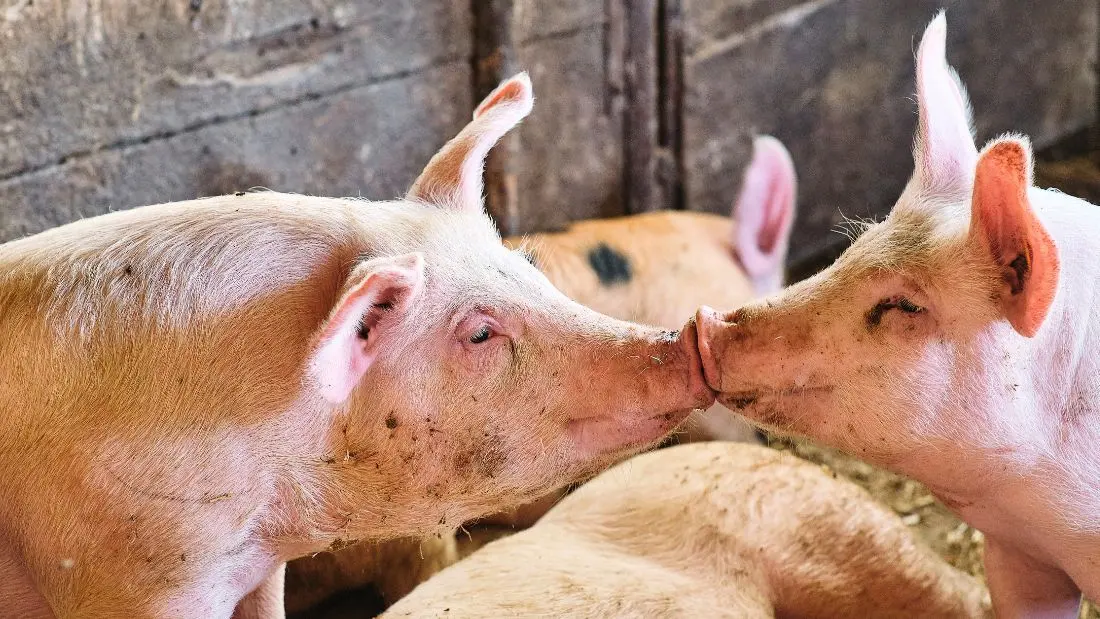
Their snouts are also very sensitive to touch and crucial to social behaviour. Pigs touch or rub their snouts when seeking comfort, resolving conflict or sleeping. They love snuggling with their noses touching.
Social creatures
Pigs naturally live in matriarchal family units called ‘sounders’, usually formed by up to four sows and their offspring. They establish a very stable hierarchy, which may include some conflicts early on but they quickly resolve these and rarely show aggression later on.
Shortly after birth, piglets begin to form relationships with their littermates and establish their position on the social dominance ladder. They fight to establish a ‘teat order,’ with bigger, more dominant piglets claiming the front teats that have more milk and this order remains strictly fixed until weaning.
Females stay in the family unit for life while males leave when they are about eight months old and join bachelor groups where they stay until they are fully grown at around three years of age. Bachelor groups enjoy play-fighting and exploring the world together but when the boars mature, they leave the group to live a solitary life and seek out females only during mating season. During that brief time, they join the female groups and temporarily change their hierarchy but leave again after a short while.
Pigs form lifelong friendships and are known to make up after a conflict – when they’ve calmed down, they lie down together and rub their snouts. They also form strong bonds with other animals and people. On the other hand, they tend to avoid people who don’t treat them well and approach strangers with caution.
Caring mums
Around 48 to 24 hours before giving birth, sows leave their group to find privacy and build a nest. They dig a shallow bed and gather branches, twigs and leaves to make it comfortable and protective. After giving birth, sows stay in isolation for about a week and then they re-join the group with their new piglets and sows take turns in taking care of them while the mother forages.
Foraging specialists
Every day, pigs spend several hours foraging, rooting through soil and even grazing. They are omnivores and their natural diet includes a wide variety of plants, roots, tubers, insects, worms, mushrooms, fallen fruit, bird eggs, seeds and small animals.
To make rooting easier, pigs have a special cartilage disc in their snout that makes it stronger and more efficient at ploughing the soil.
Smart minds
Pigs are very intelligent and have an excellent memory. In fact, scientists say they are smarter than most dogs! They learn very quickly, are very good at problem-solving and some pigs even use sticks and tree bark as a shovel to make building their nest easier.
In artificial settings, pigs can learn to play video games and operate simple systems, such as temperature controls in their barn or feeding mechanisms and they can remember these things for years.
Pigs also show emotional intelligence, recognising and mirroring one another’s moods. They are naturally very playful but can distinguish between work mode and play mode and act accordingly.
Chatty snouts
Pigs are very vocal and use their own language. Humans have so far distinguished about 20 different vocalisations – grunts and squeals – with which pigs express emotions, including excitement, joy, contentment, sadness, anger, greeting, warning, panic and more. It’s not just the type of vocalisation that matters but also its volume – from calm, quiet noises to very loud ones.
Pig mums do something else as well – they ‘sing’ to their piglets! It’s not singing like humans do but they produce a series of soft, rhythmic grunts while nursing to comfort their babies and signal when milk is flowing. And in response, piglets learn to recognise their mother’s voice from their very first day.
Are pigs dangerous?
Domesticated pigs are generally less dangerous than wild ones, simply because of their altered physicality but it depends on the situation. It’s not a good idea to come between a mother sow and her piglets and even the friendliest pig can accidentally knock you over.
The effect of farming
The conditions and treatment most farmed pigs are forced to endure are simply abysmal. None of their needs are met and every aspect of their life is severely limited or violated, which results in constant suffering. Most pigs in the UK are ultimately killed in gas chambers, a process that causes significant distress. Veterinary treatment is expensive and many pigs are left to suffer simply to save money. Every Viva! investigation over the years has revealed sick and dying animals left without help.
Sanctuary pigs
Some years ago, Viva! rescued a sow and her six piglets from a factory farm. You can see Hope’s dance of joy below when she was allowed outside for the first time at Dean Farm Animal Sanctuary. Visiting a farmed animal sanctuary is probably the closest you can get to see pigs’ natural behaviour and appreciate their unique personalities. It’s a wonderful experience and you’ll help the sanctuary too!

About the author
Veronika Prošek Charvátová
Veronika Prošek Charvátová MSc is a biologist and Viva! Health researcher. Veronika has spent years uncovering the links between nutrition and good health and is an expert on plant-based diets.