Behind the happy hen on the box is a truth the egg industry doesn’t want you to see
Help Viva! crack open the myth and expose what free range really means for hens.
I have been going inside farms for more than 30 years, and one thing that experience has taught me is this: the image sold to the public is a world away from the reality animals endure.
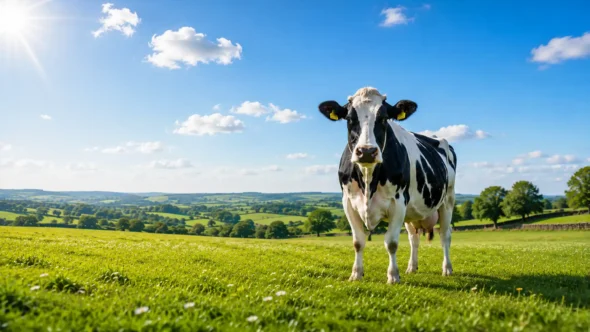
Few labels have been marketed more successfully than ‘free range’. Those two words conjure up images of hens wandering through green fields, scratching in the earth and stretching their wings in the sunshine. But behind that reassuring label can be something very different.
Three in every four eggs sold in this country now carry the label, and millions of people pay extra for them in good faith, because they want the hen to have had a decent life.
‘Free range’ does not mean hens spend their days roaming freely outdoors. By law, they must be given daytime access to an outdoor range but, as you’ll see, many rarely access it.
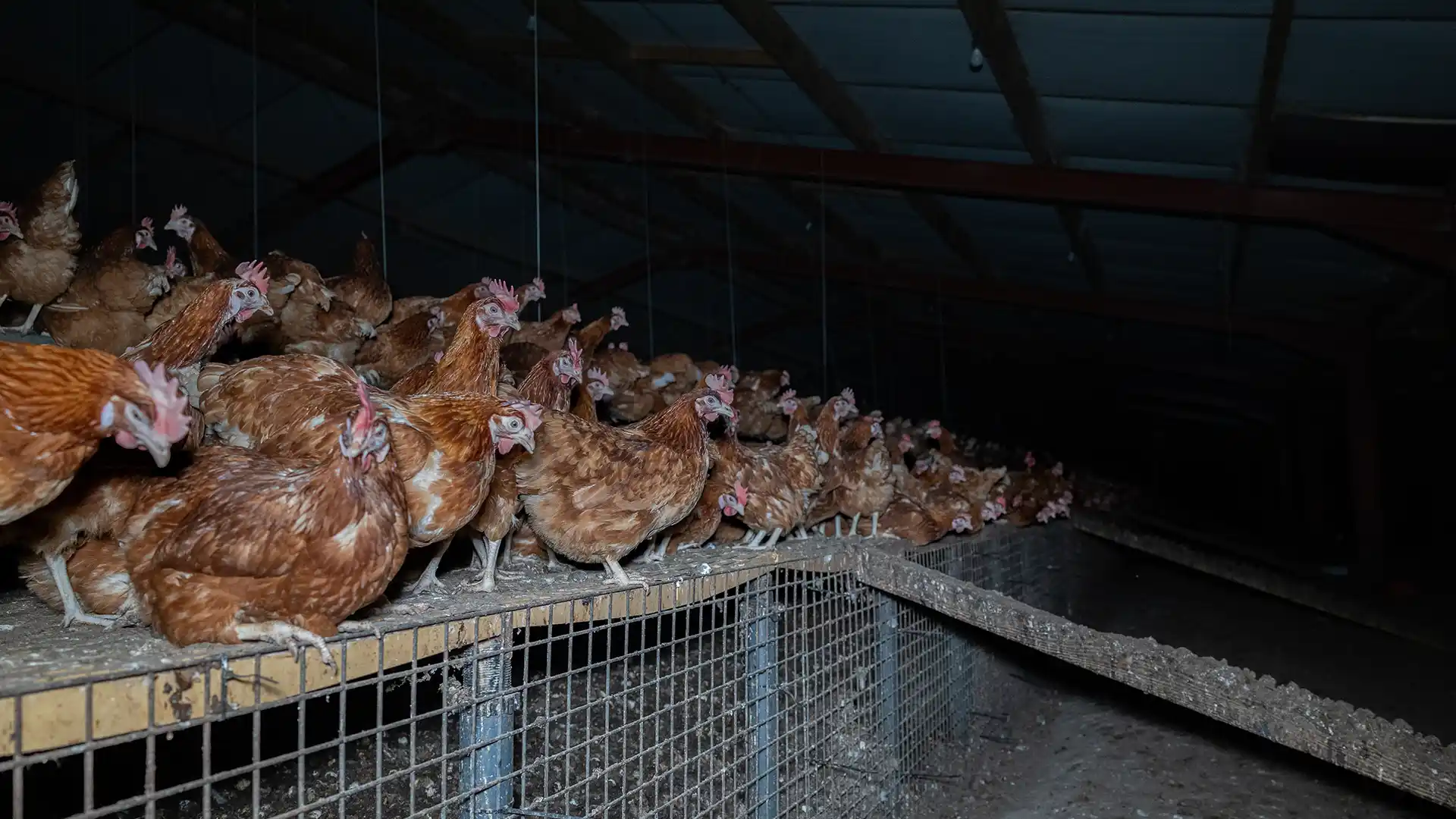
Inside they can still be stocked at up to nine hens for every square metre of usable space. And because usable space can include multiple tiers, farms can accommodate thousands by building upwards.
We put ‘free range’ to the test
There is no legal maximum on the number of hens in a free-range flock either. Even under the RSPCA Assured scheme, a free-range flock can contain up to 16,000 hens.
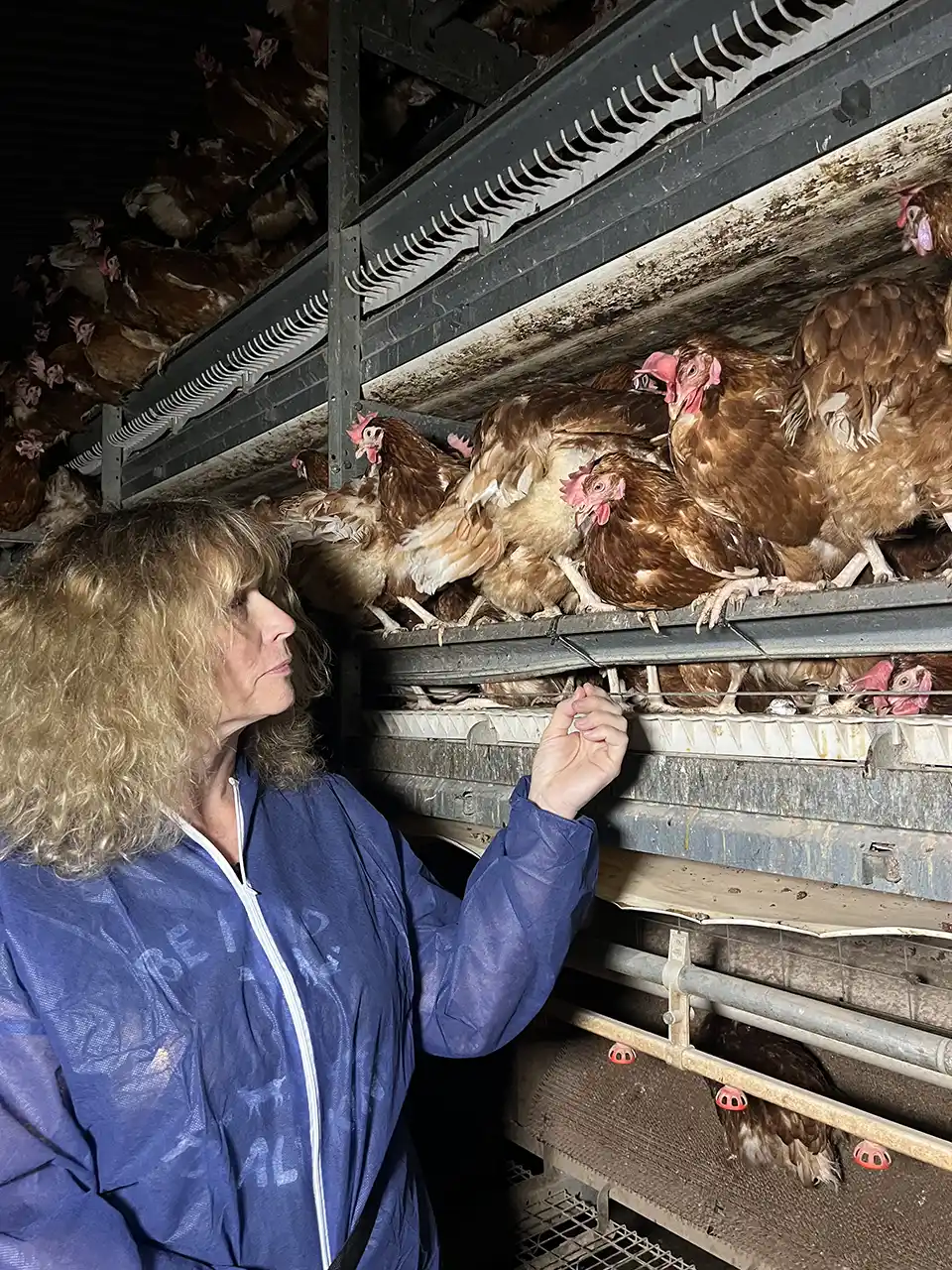
So, we put the label to the test. Our investigators went into three free-range farms in Herefordshire, all supplying Noble Foods – Britain’s largest egg company and owner of the Happy Egg Co – and all three were RSPCA Assured. My son Jazz and I went undercover at two of them.
We were not hunting for one bad apple.
These were farms operating behind two of the most reassuring messages a shopper can see on an egg box: “free range” and “RSPCA Assured”. Yet at all three we found overcrowding, layers of filth and hens dying or already dead on the floor.
Britain’s biggest egg company exposed
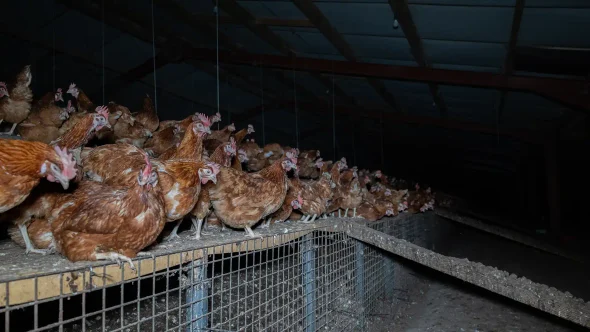
The first is Merri-Folde Farm, Garway Hill, Herefordshire. Stepping into that vast, dilapidated shed at night, it is the sheer number of hens that stays with you: thousands of birds parting around our investigators’ boots and closing behind them until the floor disappears beneath a moving mass of bodies.
Every perch and ledge is packed shockingly tight with birds standing in their own excrement. At dusk, a hen’s instinct is to fly somewhere high and safe. Here she settles into a wall of other hens, cramped and jostled until the lights come on again.
All around the farm are birds with bald backs and bare necks where other hens have torn out their feathers. Feather pecking is so familiar to the industry that it plans for it before the chick is a day old.
Her beak – the tool she uses to explore, forage and feel her way through the world – is burned back with an infrared beam. Noble Foods’ own figures show 95 per cent of its hens have this done. The law calls it a mutilation; the industry calls it ‘beak treatment’.
The hen I cannot stop thinking about
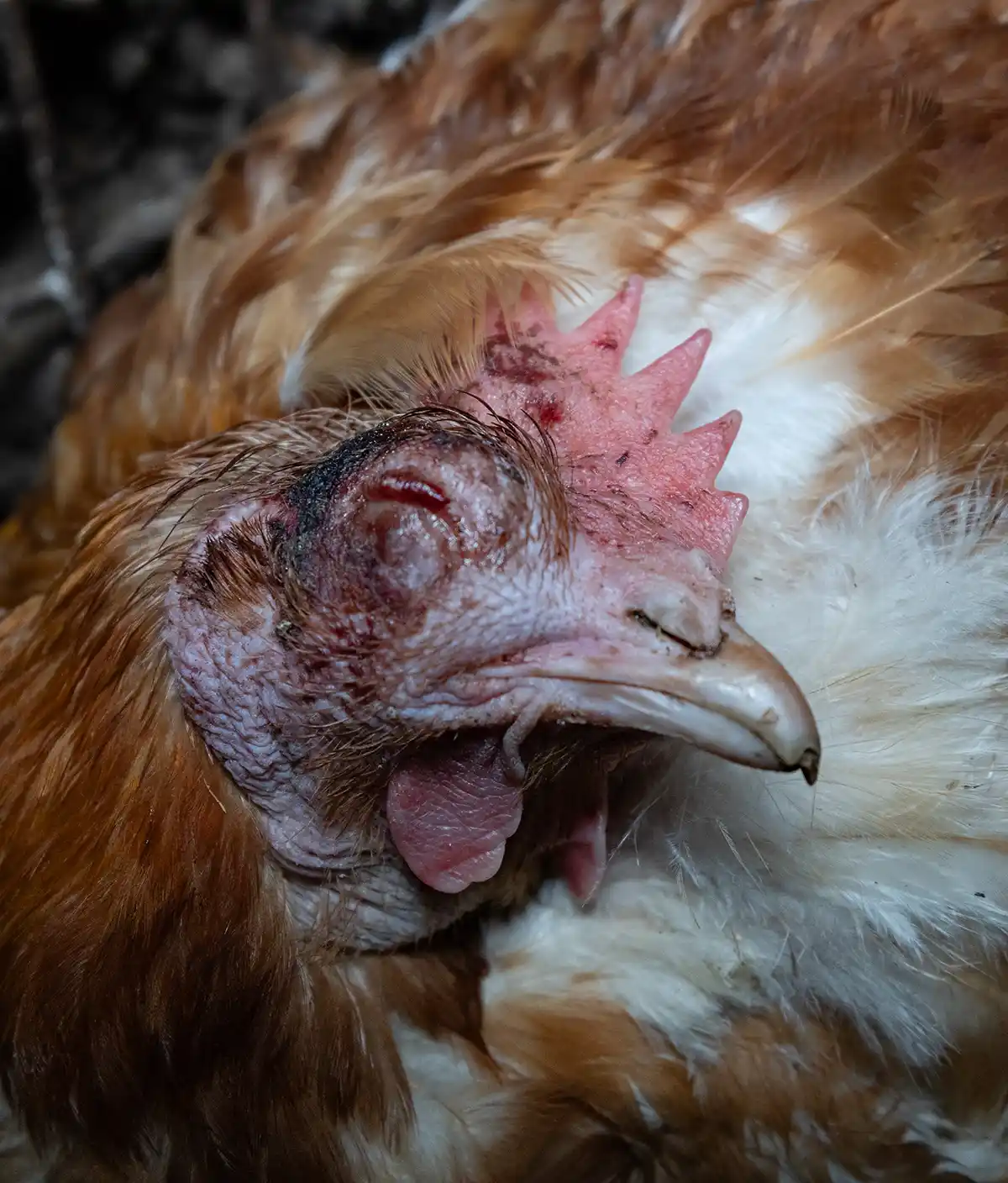
She has a devastating eye injury, probably caused by severe pecking, and she is still alive, bobbing her head from side to side as she tries to navigate a crowd she can no longer properly see.
She is not in a hospital pen and nobody is coming for her. She will remain there until she dies or is crated for slaughter with the rest.
She is why we launched ‘Help Her’ – because she had no one and she deserved so much better.
‘Help Her’ is for every hen trapped in the egg industry – whether caged or labelled ‘free range’.
Country Flavours – leaving a very bad taste
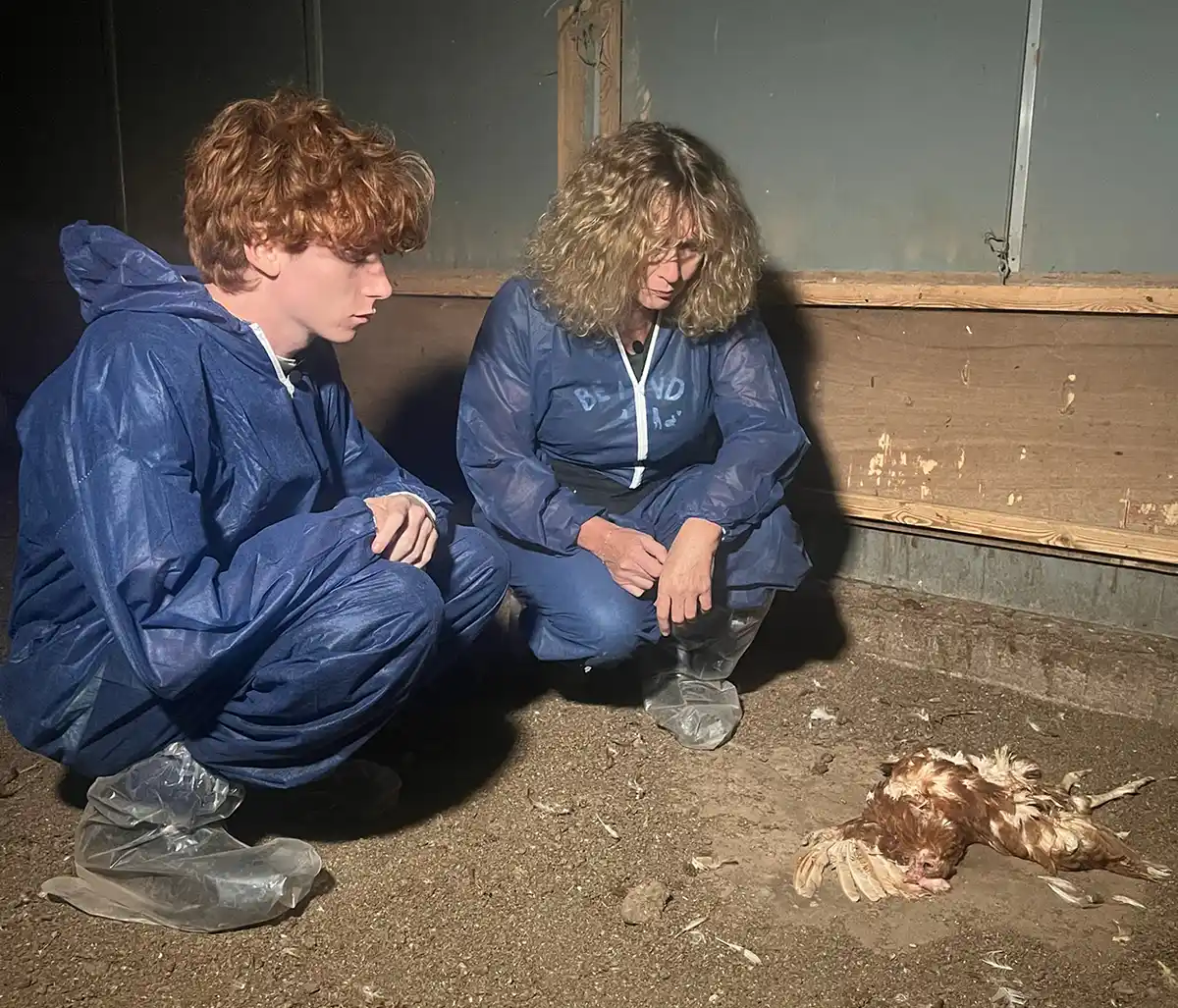
At the second, Lower Bellamore Farm, Preston-on-Wye, Herefordshire, owned by Country Flavours, I witnessed the same wall of bodies on the perches, the same bald and battered backs, the same slatted floor black with waste.
Here too, my son Jazz and I found the dead. One hen lay with her eyes pecked out. Another lay in a ring of dust where her wings had beaten against the ground as she died, alone among thousands.
These are smart animals who, given the chance, spend their days scratching through leaf litter, dust bathing and calling to one another when they find something worth sharing.
Instead, we found them crammed among thousands of strangers.
Free range – but where are the hens?
At the third, Kilforge Farm, Bolstone, Herefordshire, Jazz and I again saw similar conditions.
We went back during the day, when the popholes were open, because access to the outdoors is supposed to be the defining promise of free range…
The range was almost empty while the shed behind it heaved.
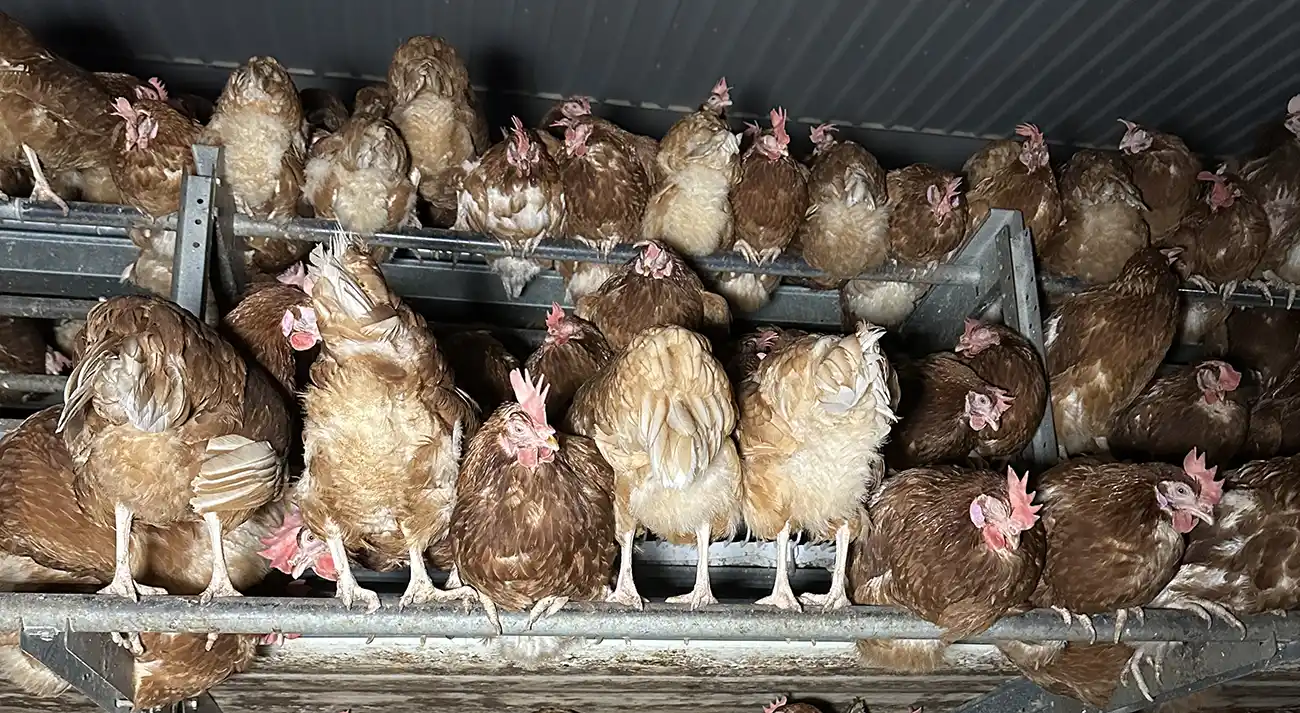
With a legal requirement of just two metres of opening for every thousand hens, a bird may have hundreds of others standing between herself and the exits.
The industry’s own research confirms the problem. A study of Happy Egg supply farms, part-sponsored by Noble Foods itself, found that on average only one hen in eight was outside, and fewer than three in every hundred ventured further than 50 metres from the shed.
Three free-range farms. Three Noble Foods suppliers. Three RSPCA Assured farms.
Yet on all three we found conditions utterly at odds with the reassuring picture those labels create: severe feather loss, filthy sheds and dead or dying hens among the living. That is why Viva! is saying plainly: No Egg Is a Good Egg.
The suffering doesn’t end with the label
The industry understands that the public wants kindness, so kindness is what it sells – picturesque fields, hens in sunshine and cosy talk of “our girls”.
Yet a free-range hen has been selectively bred to produce around 300 eggs a year, and her body pays the price. Research on commercial laying hens has found extremely high levels of breastbone fractures. Their bodies must continually supply calcium for eggshell production, and still they are required to keep laying.
And there is another victim of every box of eggs who never even reaches the farm.
Roughly half the chicks hatched for the egg industry are male. They cannot lay eggs and are considered commercially worthless. So, shortly after hatching, the males are killed.
Around 40 to 45 million day-old male chicks are killed in the UK each year. Most are from free-range farms.
For the females, the outcome is also tragic. At around 18 months old, when her egg production begins to decline, a laying hen is sent for slaughter. Most are transported in crates into carbon-dioxide gas systems.
As the gas rises, hens can be seen gasping, struggling and desperately trying to escape before they lose consciousness.
The words ‘free range’ or ‘RSPCA Assured’ do not protect her from that end.
Help us crack open the free-range lie
Viva! is taking this fight to the industry and the public, and we cannot do it without you.
With your donation, Viva! will:
- Release our three-farm investigation to the widest possible audience so the footage reaches the people buying the boxes.
- Power Help Her, putting the free-range hen and the life she really leads at the heart of our campaign.
- Take No Egg Is a Good Egg onto the streets, online and into the media, exposing male chick slaughter and the grisly truth about egg production.
- Challenge the labels, logos and ‘happy hen’ claims that dress suffering up as kindness.
- Carry out further investigations so the industry cannot hide behind packaging and PR.
- Help thousands more people leave eggs behind through our Easy Egg Swaps, so fewer hens are bred into sheds like these.
This is happening now
The hen who had been blinded in one eye is almost certainly dead. So is the hen who died in the ring of dust, and the one we found with her eyes gone. But the system that abused them is still running.
Another flock has taken their place. Another box is already on the shelf.
This is not some cruelty from the past. It is happening now, farm after farm, behind labels that reassure people everything is fine.
Please help hens today
Your gift will help us expose what is happening to hens, challenge the free-range myth and push for a future where no hen has to endure a life like this.
Yours for the animals
Juliet Gellatley
Founder & Director