



a veggie of
substance
Jenny Seagrove
by Tony Wardle
"I think we’re going to have an excellent season now
that we’ve got the wonderful James McFadden
from Motherwell alongside Wayne Rooney.” Of all the statements
I anticipated Jenny Seagrove might
make, this wasn’t one of them!
Why is one of Britain’s most sensitive and beautiful actresses – who
lives in London – getting excited about the Everton football
team? Well, the fact is her partner, theatrical producer and impresario
Bill Kenwright,
owns them and the Toffeemen have displaced Spurs
in her affection. Oh, the power of love!
To walk into anyone’s house and see that famous This is
Your Life red book on view is something of an event. Walk into
Jenny Seagrove’s elegant house in Little Venice and you’ll
see two of them neatly stacked on the grand piano – one of
her life and one of Bill’s. To say that they are both extremely
successful would be an understatement.
One of Jenny’s first screen appearances was in the film
Local Hero. She then shot to fame as Emma Harte in the 1983 TV
drama A Woman of Substance, which still rates as Channel 4’s
greatest drama success, pulling in 13.8 million viewers. Based
on Barbara Taylor Bradford’s bestseller, Jenny starred opposite
Deborah Kerr, a youthful Liam Neeson, John Mills, Gayle Hunnicut
and Miranda Richardson. It was followed by other starring
TV roles. And then she disappeared from the small
screen for 15 years to concentrate on films and theatre. She’s
back now, though, playing the barrister Jo Mills opposite Martin
Shaw’s Judge John Deed in the series of the same name.
“Judge John Deed is an extremely happy shoot. One of the
ex cast wrote saying how much he’d enjoyed working on the
production and added, ‘It must have been the catering’ – it’s
all strictly vegetarian. This makes life an absolute delight and
the food is so good. It’s all down to Gordon Newman, the
writer and producer, who sets the ethos for the shoot.”
Vegetarianism is clearly important to Jenny. “It is a part
of my life, central to my beliefs because I am passionate about
animal rights. I’ve been fighting for them in one way or
another most of my life. I’m not a violent person and don’t
believe in using violence but when you see the torture and pain
to which so many animals are subjected I can fully understand why
people do break down doors or smash cages to free them.”
Jenny’s awareness of animals as sentient, feeling creatures
was not a sudden Damascene conversion but grew over the years.
Born in what was Malaya – now Malaysia – in 1958, she
was first influenced by her mother’s love of animals. Most
kids get excited by their first cat or hamster but Jenny remembers
playing with baby apes and bears. That came to an end when she
moved to boarding school in the UK at just nine years old.
Although not veggie, her first husband was Indian actor Madhav
Sharma, who introduced her to the ancient concept of Ahimsa – stepping
lightly through life and doing as little damage as possible in
your passing. That includes not damaging animals.
It took another step forward when Pamela Stephenson launched her
Parents for Safe Food Campaign, revealing the appalling cocktail
of chemicals that much children’s food contains. That spurred
Jenny into eating only organic foods whenever possible but she
soon became aware that it wasn’t the entire answer, merely
a start. Of course it does improve animal welfare and reduces the
onslaught that livestock farming has on the environment but nevertheless,
animals are still killed in the same slaughterhouses. And Jenny
Seagrove did not want to
be a party to that. She can’t remember exactly when
she gave up meat but the thinking which led to it was crystal clear.
“It’s so obvious that animals have feelings and experience
much the same emotions as we do – joy and happiness, fear
and grief and they have an emotional memory. You can see an animal
working things out in its mind. It may not be exactly the same
as our mind but it is equally complex and they are sentient beings
with a soul.
“Anyone who has a dog knows this is true. I love dogs. I
love their companionability and when you have a dog there is another
heartbeat in the house.”
As Jenny speaks she briskly tries to towel away the mud and pond-water
smell from Gizzie, her extremely affectionate Springer Spaniel
who accompanies Jenny on all her film locations. He looks as though
he would sooner keep the mud – and the smell.
“If you’ve been out and come home, there is an entirely
different feeling to a house where there is dog waiting for you.
When my last old Spaniel died I truly grieved because I had lost
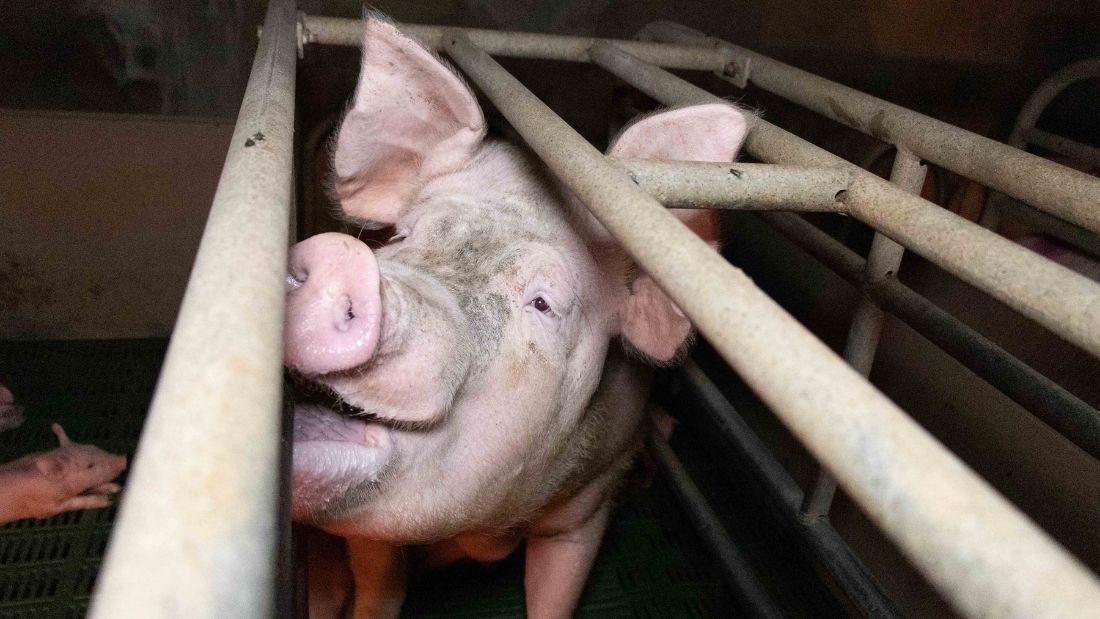
a member of my family. There is little difference between the sensitivity
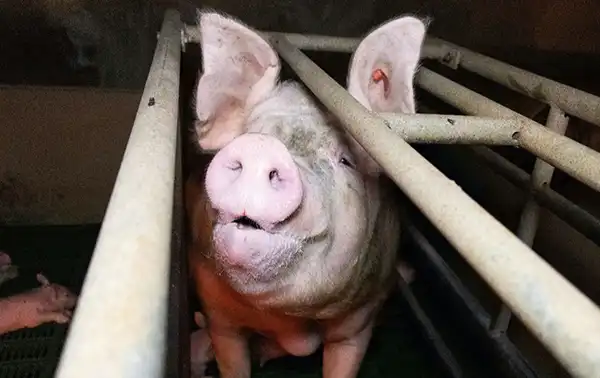
of a dog and the pigs who are crammed into factory farms or any
other farmed animal. People simply close their eyes and their minds
to the cruelty and abuse because it’s convenient to do so.
“I am convinced that if the entire population had to watch
footage of the undercover exposes that Viva! does, half of them
would immediately go veggie.”
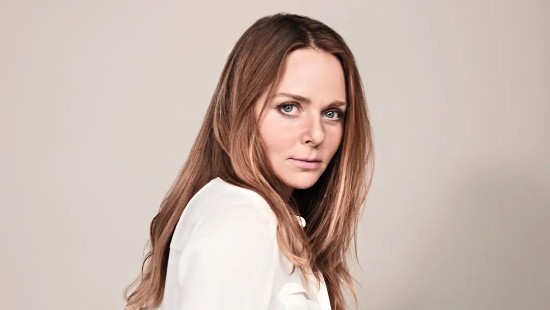
Jenny Seagrove is slight and slim and gorgeous and seen as something
of a national treasure. But she’s also active for animals.
In the past she has given her backing to several groups and has
been vocal in her support. When she says she wants to help you,
she means it. Jenny now appears in our Gifts for Life catalogue
and fronts our super new Christmas Feast leaflet.
I first met her on the Judge John Deed location. ‘Met’ doesn’t
really describe it accurately. I was filming Martin Shaw for our
anti-factory farming video, Not in My Name, in the rambling acres
where the series is shot. Jenny appeared in another part of the
grounds and Martin suggested I try and recruit her. I chased after
her and when I eventually caught up I was so out of breath I could
barely speak.
I tried to gasp out an explanation in staccato, solitary words,
her blue eyes holding me unblinkingly. ‘This man’s
a freak’ – that’s what they seemed to say – but
I managed to get out the word Viva! and the blue eyes blinked: “Of
course I know Viva! and yes I’ll do anything I can to help.” And
she has – and we thank her most sincerely.
Jenny is very careful about her health and says proudly that she
has never missed a day’s work in her life. As well as her
low-fat vegetarian diet she takes selected supplements. Supplements!
If you want to see Jenny’s eyes flash with anger just mention
that word and the EU directive that outlaws many of them.
“I cannot imagine why people take HRT (hormone replacement
therapy). It is mare’s urine, unspeakably cruel and it kills
people. Meat also kills people yet neither of these is banned but
a whole range of vitamins and herbal supplements are banned on
the basis of virtually no science whatsoever. If I develop something
like cancer I will not take chemicals and pills or undergo chemotherapy.
I will rely on naturopathic and herbal remedies and hope they work.”
But she wasn’t always healthy. In her late teens she became
anorexic. Whenever that word is mentioned in conjunction with vegetarianism
my heart sinks because there have been unscrupulous attempts to
link the two. Of course it’s nonsense and the science shows
it to be. In Jenny’s case, the anorexia happened long before
she became veggie.
“It was all tied up with unresolved family issues but triggered
when a friend of mine was photographed by David Bailey. He made
her look absolutely gorgeous while I, at that time, was chunky
and wore glasses and felt far from gorgeous. I decided to lose
weight and suddenly it gained me
some attention. So, I lost more weight and the attention increased – and
so
it went on.”
If she was ever an ugly duckling, she certainly turned into an
elegant swan many Springs ago and has graced a whole string of
movies with her beauty, usually in the starring role. So it comes
as a bit of a shock when she says:
“I have often thought of giving up this silly job of acting
and working at the sharp end for animals. But in the end I have
decided to carry on acting and use my position to help gain what
publicity I can for them.”
Jenny Seagrove does turn work down if it clashes with her beliefs.
How, I wondered, did the blood and guts of her Hammer House of
Horror roles fit in with that.
“Its all comic book stuff really and the blood is phoney
so if people want to be frightened, that’s up to them. I
did have reservations about a film called The Guardian, which was
very violent but it was an extremely good script and a bit surreal
so I felt it was far enough away from reality and decided to do
it. It’s now become something of a cult film.”
Jenny has done voice overs on anti-vivisection videos and in her
role as Jo Mills, reality and fiction sometimes meet, which pleases
her.
“When you see footage taken inside laboratories it shows
animals being tortured – there is no other way of putting
it. One of the Judge John Deed storylines was of a young man who
needed a heart transplant but refused it because of the animal
experimentation done in the process of perfecting the techniques.
Jo defended his right to refuse and I think that’s why people
like Jo Mills, she is prepared to take on cases with a strong
ethical component.
“I am genuinely proud to be part of this drama and working
with Martin Shaw is a delight. We have an empathy – often
unspoken communication – and understand how each other works.
We know exactly what the other is thinking and what they are going
to do in a given situation. We operate the same way so I am working
with mates, with a shared ethos and that is unique and a wonderful
way to spend your working day.”
Jenny believes that vegetarianism is a vital way forward for individuals
and the planet but isn’t strident about it, putting her faith
in education and gentle persuasion. Perhaps it works as Bill Kenwright
isn’t veggie – or at least he wasn’t.
“Bill had a key moment a few months ago when he got up one
morning and watched a TV programme about an abattoir. When I appeared
he told me about it. “It was horrible”, he said, “I
wish I could be like you – a vegetarian.” I simply
answered, “So what’s stopping you?” He thought
for a moment and replied, “Nothing!” and gave up meat
that day.
“He added something so poignant that I’ll never forget
it. ‘It’s very painful loving animals.’ And he’s
right. You see their transparent happiness and their dependability
on humans but you also see how frequently they are let down.”
|